

AI prompt examples are ready-made instructions you give ChatGPT or Gemini to get useful, specific answers instead of generic ones. The best prompts set a role, task, context, and format — and this page gives you 70+ copy-paste examples for writing, marketing, business, coding, study, and daily productivity.
Most people type a one-line question into ChatGPT and get a bland answer. The secret isn’t a “magic” prompt — it’s structure. Tell the AI who to be, what to do, with what context, and in what format, and the quality jumps. Below is the formula, then 70+ prompts you can copy and adapt in seconds. For visuals, pair this with our AI image prompts guide.
The AI prompt formula (RTCF)
Four parts turn a weak prompt into a strong one:
- Role — who the AI should act as (“Act as an experienced SEO copywriter”).
- Task — exactly what you want (“write 5 meta descriptions”).
- Context — the background it needs (“for a Coimbatore digital marketing academy targeting beginners”).
- Format — how the answer should look (“as a numbered list, each under 155 characters”).
Don’t ask a question. Give an assignment — with a role, a task, context, and a format.
Writing & content prompts
Marketing & social media prompts
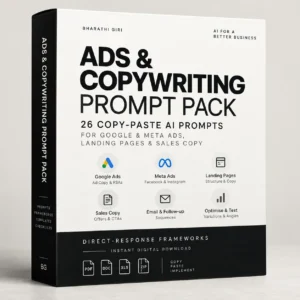
Want a tested library of prompts, organised and ready?
My AI prompt packs collect the best prompts for marketing, business, and content — categorised, tested, and formatted for ChatGPT & Gemini. Grab them from the shop, or read our best ChatGPT prompts guide first.
Browse the prompt packs →Business & productivity prompts
Coding & tech prompts
Study & learning prompts
Everyday life prompts
Pro tips for better AI answers
- Give it a role. “Act as a…” instantly sharpens the tone and expertise.
- Add context. The more it knows about your situation, the better the answer.
- Specify the format. Ask for a table, list, word count, or tone.
- Iterate. If the first answer is off, say what to change rather than starting over.
- Ask it to ask you. “Ask me any questions you need before answering” gets far better results.
- Always verify facts. AI can sound confident and still be wrong — check anything important.
Remember: AI is an assistant, not an authority. Use it to draft, brainstorm, and speed up — then apply your own judgment, especially for anything factual, legal, financial, or medical.
- Use the RTCF formula: Role + Task + Context + Format.
- Copy the 70+ examples above and swap in your details.
- Add a role and context for a big quality jump.
- Iterate and refine instead of restarting.
- Always verify important facts before you act on them.
Frequently asked questions
What are AI prompt examples?
AI prompt examples are ready-made instructions you give a tool like ChatGPT or Gemini to get useful, specific answers. Good examples set a role, task, context, and format so the AI produces something you can actually use instead of a generic response.
What is the best ChatGPT prompt formula?
The RTCF formula: Role (who the AI should act as), Task (exactly what you want), Context (the background it needs), and Format (how the answer should look). For example: “Act as an SEO copywriter. Write 5 meta descriptions for a Coimbatore academy, as a numbered list under 155 characters.”
Are these prompts free to use?
Yes — every prompt on this page is free to copy, paste, and adapt. If you want a larger, organised, tested library sorted by category, our prompt packs in the shop save you time, but you can get great results from these examples alone.
Do the same prompts work in ChatGPT and Gemini?
Mostly yes. The RTCF structure works across ChatGPT, Gemini, Claude, and most AI assistants. You may need small tweaks for each tool’s style, but the core prompt stays the same.
How can I make ChatGPT give better answers?
Give it a role, add context about your situation, specify the format you want, and iterate by telling it what to change. You can also ask it to ask you clarifying questions before it answers — this single trick dramatically improves quality.
Can I trust everything AI tells me?
No. AI can sound confident and still be wrong, so always verify anything important — especially factual, legal, financial, or medical information. Treat AI as a fast assistant for drafting and brainstorming, then apply your own judgment.